Surviving sensory overload.

No two brains are the same; this is both the beauty of humanity as well as the curse of brain injuries. It can be quite frustrating that the uniqueness of our brains means there is no one-size-fits-all treatment when it comes to many concussion symptoms; in fact, what is effective/ineffective not only varies from person to person, but can change concussion to concussion for the same person (I can tell you firsthand that this is incredibly frustrating!). In a previous post, I explained that for me, managing sensory overload is often more about reconciling than reducing stimuli. So, what does that actually mean and look like?

Example: it’s been a long week. I have asked a lot of my brain, and it’s getting pretty tuckered out. I’m finally home, hanging out in my chair in front of the TV. I feel tired/drained, but nothing too out of the norm. After a few minutes, I realize that I’ve been bouncing my leg. I don’t feel anxious or overstimulated (yet!)…but I know that my bouncing leg is how my brain warns me it needs a timeout or else it is going to go rogue. My brain is overstimulated…so obviously, now is a good time to play video games!

I know – it sounds counter-intuitive, right? Allow me one caveat, however: I am not talking about playing Call of Duty online with your friends in front of a 4K screen – I feel overwhelmed just thinking about that! For me, when I know my brain is overwhelmed and I have the space/time to do it, I like to sit down in front of my Nintendo classic(s) and play some Zelda or Super Mario (if I’m in a good place in recovery, I can even manage Donkey Kong…but generally, sticking to games which don’t require a quick response time are my jam); think 8 or 16-bit slow-moving, chill games. Super Mario Brothers (1985) is my go-to when I’m really struggling; it captivates and calms my brain, but I can also count on hours of muscle memory to kick in when my brain doesn’t (all those hours playing my Game Boy Color have totally paid off!). Again, for my brain, it’s all about sensory reconciliation: what I am seeing/hearing/feeling are all tied in to keeping Mario alive (hopefully). My brain is engaged enough to not be wandering all over the place, but not so much that it’s overwhelmed and disengaging. Even though Mario may not survive, my brain will, and sometimes that feels huge.

While we’re on the topic of the use of video games in recovery:
if you haven’t heard of her, research Jane McGonigal and her amazing game Superbetter; it may help you or someone you know (no concussion count required!)
Managing sensory overload.

We live in a world which constantly bombards us with stimuli. Sometimes that is exciting and invigorating; other times, exhausting and overwhelming. For those of us who are particularly prone to sensory overload, a world full of stimuli can often feel like a world which we can barely survive. What if we don’t want to just survive – what if we want to thrive?

For me, learning to move past survival mode took a while, but I am so glad I finally took steps forward. The first step was realizing that I did not have to be at the mercy of stimulus; the second step was accepting that would mean making some life changes. The second part was the hardest part; making life changes felt a lot like defeat most days, but forcing myself to look at what I would gain rather than what I was losing was always helpful.

Ultimately, what I have found to be most helpful is viewing stimulus tolerance as something which I could/should budget. While this isn’t something I can really quantify, an informed, educated, experienced estimate is usually possible. I have learned that I really cannot take it day by day – I almost have to take it week by week. Tomorrow’s accomplishments depend on today’s choices, so thinking ahead is a must! Here are some examples of what that means for me:

  • My longest day is followed by the day I work from home. By the time Tuesday night rolls around, my brain is usually feeling pretty wiped. Working from home the next day means I can get a little more sleep, and I have significantly less stimulus (no commute, no noisy office, etc…). I can push myself a bit more on Tuesday because I know that overall, Wednesday is going to be more brain-friendly.
  • I have started inviting people to come to me. In a lot of ways, this is for much the same reason as the Tuesday/Wednesday concept: having them come to me means my environment is controlled and familiar, and energy I want to spend interacting with them hasn’t been “wasted” on driving or the distractions which come from being somewhere other than your own home.
  • Knowing my own limitations is crucial. If I want to participate in a conversation (as opposed to sitting there with a vacant look the whole time), it means there can’t really be more than two or three other people, and it needs to be in a quiet, calm environment.
  • Travel has to be thought through. I was recently stuck in an airport for nine hours on my way home. While I would not have done this previously, I paid the $35 to be in a quiet lounge – I knew that $35 would mean all the difference the next day when I was sitting at my desk.

Learning all of this has not come easily. There are still days when I mourn the loss of “normal life”: being able to sit in a coffee shop with a group of friends and discuss theology; going to a concert; people watching in a busy airport. That said, learning to keep my brain happy is what enables me to get the most out of life.

Avoiding sensory overload.

I have a reputation for always doing things the hard way and stubbornly pushing through things when I shouldn’t (ask any of my concussion rehab providers). I am willing to bet money that my last words will likely be “I got this/I’m good!”…so when I say that avoiding sensory overload is the way to go, please pay attention. I am not proposing sensory deprivation (although that sometimes sounds like a lovely idea!); however, balance is our friend. Additionally, remember that we’re discussing sensory overload, not stimulus in general – there is a whole world out there, and tolerating stimulus is part of the human adventure.

For me, the first step in learning to avoid sensory overload was figuring out how to conceptualize the issue. I started to pay attention to what sensory overload looked like for me (anxiety, inhibited communication, inability to focus, increased pain – the list goes on). As I gained a deeper understanding of the issue, my perspective(s) began to shift. I began to realize some of the impact that sensory overload was having on my life: the toll it was taking on relationships; the increased exhaustion, both mentally and physically; really, my quality of life overall. Interestingly, it also helped me see stimulus in a more positive way. I slowly began to realize that stimulus wasn’t the problem; rather, the problem was my inability to measure stimulus, calculate it’s impact on my day-to-day, and adjust my trajectory when necessary. Sensory overload isn’t something I can or should push through!

Sundays: my number one source of sensory overload. I had not yet identified sensory overload as an issue, and certainly hadn’t realized that it was the primary source of my anxiety; I just knew that when I got to church, my anxiety spiked and things got messy (more on that later…maybe). I started sitting exclusively in the balcony, thinking that being able to see everything and being somewhat separate would help abate my anxiety. NOPE! The anxiety only continued to build, week after week. I had no idea that my “safe” place was possibly one of the worst places for me to be! Once I realized the impact of stimulus in my life, I realized that being up in the balcony, where sounds seem more amplified and every little movement can be observed, was the last place I should be. I felt so defeated when I realized that my previous, uninformed solution was actually making everything worse!

As much as I dislike it, being able to calmly sit through church means:

  • walking in at the last moment (fewer people milling about = reduced visual stimulus),
  • sitting in the very front (I am so glad that lovely friends of mine, who have patiently learned with me how to keep my brain happy, happen to already sit up there!), and
  • shooting out the door the moment church is over (again, fewer people milling about! Bonus: those lovely friends of mine know why I’m sprinting out the door – I don’t have to explain, apologize, or make excuses).

I miss being one of those who is milling about, catching up with my friends. I miss being able to sleep through the service without my pastor noticing (this is largely a joke – except for that one time…). On a cognitive level, I miss hearing the sermon and actually being able to remember and absorb it (the joy of cognitive deficits). I am still figuring this all out. I am still learning how to measure the amount of stimulus I will encounter driving to/from and being in church, how to calculate the impact attending will have on the rest of my week, and figuring out how to make it a priority while also ensuring I will still have the energy to get up the next morning and survive my workweek. I’m trying to remember that when sensory overload is rearing it’s ugly head, my face goes flat and words become hard – this is super important for me to remember, because that can so easily be interpreted as a lack of caring, or me being upset/angry. I haven’t figured out what to do about that yet, but acknowledging it and sharing about it seem like good first steps.

Sensory overload doesn’t have to hold you hostage…but it can if you let it. Acknowledging the power stimulus can have in my life has made a huge difference; learning to respond to it appropriately has helped me feel less like my brain has been hijacked, and more like my brain is a new partner I need to learn to work with. It isn’t easy, and it isn’t fun…but it beats the alternative.

Sensory sensibility, part two.

ILLUSTRATION BY ALOIS DI LEO

Part one concluded with us walking around a corner together…right into the middle of all of this. My brain is starting to power down as a result of overwhelming stimulus; in addition, it is also inducing anxiety, a less-than-subtle cue to the rest of my system that something is really wrong.

So what do we do?  We find a safe place.

It took me a long time to figure out what a safe place for my melting brain should look like, or even that it needed one. I knew something was up; I would come home from a long day at work and my mind would just be done. Sometimes that felt like I had a cement block in my skull; other times, my brain was like a puppy surrounded by squirrels – getting it to focus on anything seemed an insurmountable task.

Recognizing that my brain was overwhelmed and exhausted, I would curl up on the couch in front of the TV – what’s more mindless than television, right?! No matter how mindless whatever I was watching was, I was still unable to quiet my mind and manage my anxiety. I was perplexed by the obvious contradiction: my brain needs a break, yet even with the TV to zone out to, I would still find myself tinkering on my phone or multi-tasking in some other way, as anxiety and restlessness coursed through me. It was a relief when I finally realized a direct correlation between anxiety and stimulus…but if I couldn’t figure out how to respond to sensory overload, I would not be able to actually manage my anxiety. If tinkering on my phone in front of the TV while my leg bounced up and down wasn’t cutting it, what would? What would it take to calm my brain and body, giving both the break they needed? From the beginning, I had looked at the problem purely in terms of numbers: lots of stimulus is bad, so less is good…right?

It took a while, and I stumbled across the solution by accident, but I finally learned that for my broken little brain, it needed a break from unreconciled stimulus. My brain was being drained not so much by the stimuli themselves, but by constantly having to identify each stimulus and figure out where it fit. My brain didn’t want to be placed on a timeout – it just wanted one engaging thing to focus on, and an opportunity to tune everything else out. It may sound simple enough, but identifying this was HUGE. I started off thinking I needed to find a “safe place”…but it turns out that knowing what my brain needs means I can make a lot of spaces safe, giving me one more way I can feel a sense of freedom and control in my recovery process.

I’ll be sharing in another post some of the tools I have found to manage the stimulus and subsequent anxiety (and therefore my brain)…

Sensory sensibility, part one.

ILLUSTRATION BY ALOIS DI LEO

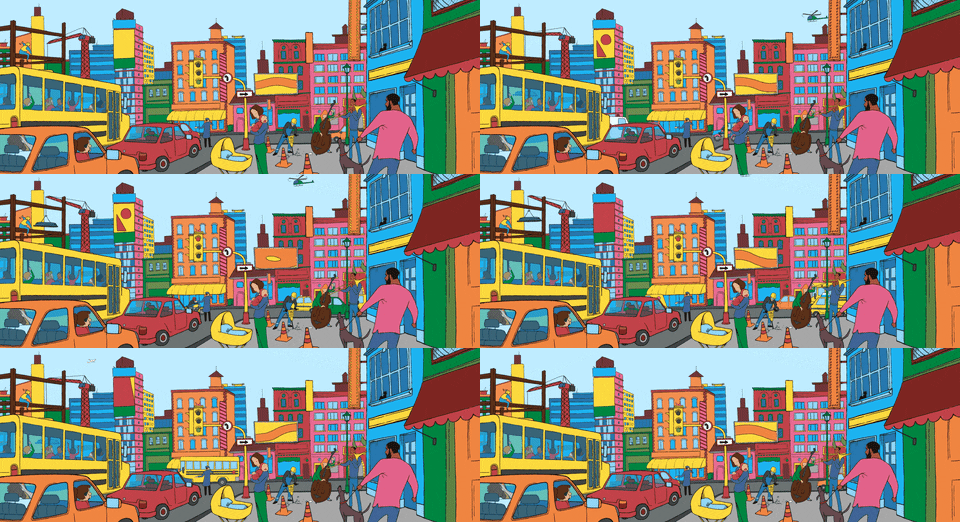
Stop for a moment and take in the scene – really look around. For those of us accustom to city life, it looks pretty normal, right?

Now start adding the layers.

Look closer at all the movement. Everyone and everything seems to be moving, but none of those movements seem abnormal, right? To the average person, it’s just another day in the neighborhood. Add in the smells: dog, smog, cement dust. Getting a little more real, but nothing too bad, right? What sensations do you feel? A light breeze, the feeling of the concrete shaking beneath you, maybe warmth from the coffee cup in your hands. Now for the sounds: an airplane…then a helicopter. A dog barking at the birds chirping from their nest on the stoplight. The crying baby near the musicians who continue to play on despite the jackhammer next to them. The traffic cop blowing his whistle at the cars that are noisily zooming by. The woman on her cellphone in the car next to you – you can hear her talking, but can’t quite tell what she’s saying over the sounds of an idling bus and the rambunctious children it contains. At this point, can anyone even pick out the sound of the steelworker hammering, or the noises filling the work site the crane is at?

Go back and look at the picture again.  Now what do you see?

Perhaps you now see what I immediately saw: commotion and (relatively controlled) chaos. A few years ago, being in this scene would have invigorated me; now, my brain doesn’t know what to focus on – there’s simply too much happening, so my brain begins hemorrhaging power.

Imagine we are walking down this sidewalk together – we’ve just rounded the corner and stepped right into the middle of all this. Our conversation stops because I can’t seem to come up with more than one or two monosyllabic words, which come out in a flat, dead tone. You say my name a few times, and when I do finally realize you’re saying something, I seem dazed and a little confused. My face and affect are flat, my eyes wide. You reach out to touch my arm, and I startle (and, knowing me, likely spill the coffee in my hand). My anxiety increases as my mental capacity decreases; my brain is completely overwhelmed! I can’t focus well enough to tell you what I need; in fact, it was only a few concussions ago when I realized that all of this is being driven by stimulus.

So here we are, standing in the middle of the sidewalk, surrounded by the sights/sounds/smells of life (including my coffee-drenched sleeve). I look at you, my face blank and absent; you look at me, uncertain and concerned.

So now what?

*Stay tuned for part two*