Brain blame games, part two.

So what changed? I learned where else to place the blame. Oh, not what you were expecting to hear?

I slowly began to learn that blaming my brain was simply too broad a complaint, and that it (ironically) limited my ability to be hopeful about recovery. The biggest steps forward came from understanding how injuring my brain affects my eyes. Eye dysfunction can have a huge impact in life overall! If my eyes are sending completely different reports to my brain, my poor brain is having to work so much harder, as it now has to decode the messages and figure out what is actually going on; this, in turn, has a significant impact on cognition. If my brain is having to put so much work into figuring out what I am seeing, it’s that much harder for it to do other things. For example, if my brain is fighting just to figure out which line I am trying to read in a paragraph, of course it is going to be more difficult to actually remember what was written in that line.

This was a massive game-changer! I cannot express what a difference it made to reframe the thought “I can’t remember anything I read because my stupid brain is broken” to “OT will help my eyes do their job better, so my brain can do it’s job better; maybe then I’ll be able to curl up with a book again!”. I began to feel so much less helpless and frustrated; I finally felt like I was no longer hijacked by a broken brain, and had renewed faith in all the various rehab exercises I was doing. I could now face each new concussion with the thought “such-and-such is on the fritz, so I need to check in with so-and-so (OT, PT, SP) to get a tune-up” rather than “oh great – I just screwed everything up even more, and now my brain is that much more useless”. I cannot emphasize how important this has been: when you’re dealing with injuries that already have issues like anxiety and depression as symptoms, knowing that not all is lost can make all the difference in the world. Now, when I whack my head and find that the carpet appears to be rolling like the ocean, I remind myself that I have a super awesome OT and Neuro-Optometrist, and that we will work together to make the carpet stop moving.

Does this mean everything is rainbows and roses now? No. There are still things my brain cannot do that it used to be able to…but I’ve learned to accept that, and put my energy into fixing what I can and adapting to what I cannot. It’s a process, and I still have to remind myself to choose to embrace this perspective, but it has made such a profound difference already, and I’m looking forward to seeing the impact in the future as well.
Brain blame games, part one.

If we go back about three years/nine concussions ago, we would find a very different version of concussed me. EVERYTHING was frustrating and disheartening. Occupational Therapy made me want to cry: how can a string with some beads on it make me feel so broken?! Speech Therapy was soul-crushing: no, I really don’t remember the string of words you just read to me. The list of frustrations, “setbacks”, and deficits seemed utterly insurmountable most days…and it was just the beginning.

A couple concussions later found me in an even darker place. At one point, I was seeing four PT’s, one OT, one SP, one Neuro-Optometrist, and four MD specialists. When I would check in at the rehab desk, they no longer asked my name – they’d ask which therapist I was there to see (or, on bad days, tell me which therapist I was there to see). Life outside rehab wasn’t any easier. I couldn’t drive, so I would often take the bus everywhere. I couldn’t walk a straight line so I was often mistaken as being drunk; this led to some pretty unsettling interactions with strange men at bus stops (bonus: since it was early spring, it would get dark quite early, which really adds a special something to interactions with skeevy individuals). It was ~3 months before I was cleared to return back to work, so I was bored out of my mind. I tried to find things to occupy my time; for example, I tried to learn to knit. Despite learning the absolute easiest, three-step knitting technique, I would get stuck every few minutes, and have to ask my endlessly-patient friend where I was at in the process, and how to continue. I was in my early-thirties, failing at tasks demented senior citizens could do; I was despondent.

Since my brain was what had been injured, all of this fall-out must be my brain’s fault, right? At some point, it had all become clear to me: my brain was public enemy number one, and all hope was officially lost. What I failed to realize at the time was that my biggest challenge wasn’t my brain – it was my attitude. I had no idea how to move forward, what hopes or plans for the future seemed feasible; I had no idea how to go back to simply living life.

*Stay tuned for part two.*

Life after concussion(s).

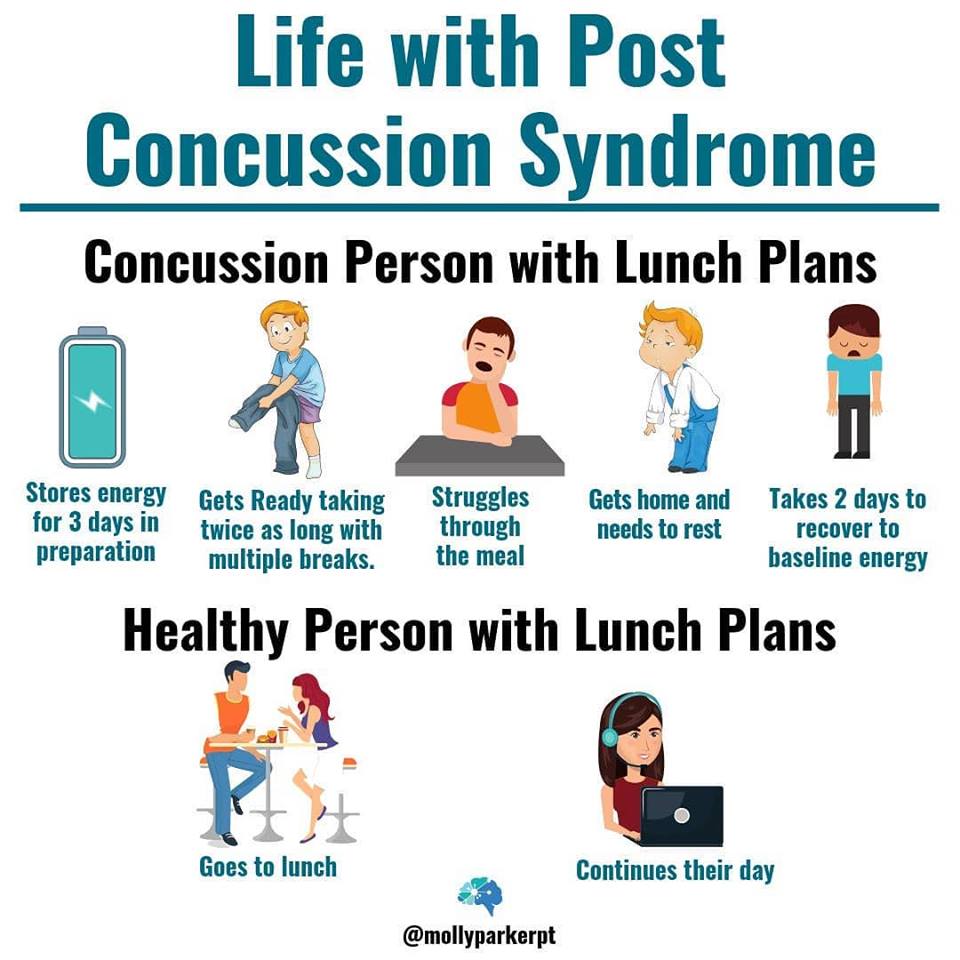
used with permission: @mollyparkerpt

I really appreciate this illustration. While I cannot speak for others, I find that it rings quite true for me. Budgeting my life has become a necessity, more so than for others. When I think through activities I plan to partake in throughout the week, I have to assign them a value – an estimate of how much energy I think each activity will require. But what happens when your week deviates from your stringent calculations, and the realities of life don’t match your calculations on paper? What happens when a family member has a personal crisis? Someone you love has a terrible accident? Work takes more out of you than normal? Allergies knock you down? What happens when there are successive weeks of this?

NOTHING; nothing happens.

Dishes and laundry pile up. Grocery shopping doesn’t happen. Your car, once pristine, slowly begins to look as if you live in it; you start to suspect that the baristas at your nearby drive-thru Starbucks recognize your voice, and you’re too tired to think anything other than “oh good, they’ll know it’s me and my order won’t get too screwed up”. Before you know it, you’re buried beneath obligations, outstanding chores, dirty clothes and laundry, a stinky dog, a needy cat…and you’re still having to divert all your energy outside of your home, to the job that keeps your bills paid and provides you with the blessing of health insurance.

Life doesn’t stop. Obligations don’t dissipate, houses don’t clean themselves, blog posts don’t spontaneously appear. Look again at the illustration above. If you’re in the top row: be gracious and kind to yourself; it won’t be this way forever. It’s my experience that you’ll either learn to compensate or begin to recover; if you’re lucky, both. Hang in there, do what you can, and ask for help if/when you need it. If you’re in the bottom row: just be glad I made it to lunch. I say that jokingly…but also seriously. Be encouraging. Pretend you don’t notice I am wearing pajama bottoms. No, I didn’t shower before we met up…but please don’t take that personally – I woke up and decided that spending time with you was more important than freshly washed hair, and it really was an either/or that morning.

Why the blog?

Why am I writing this blog? What is the point?

There are an increasing number of resources out there for concussion recovery and Post Concussion Syndrome (PCS). Over the last few years, I have combed through and read over many websites and blogs; suffice to say, there are a lot of voices out there with a lot of different things to say. Nonetheless, as I read through all of this (particularly the blogs), I noticed one voice was missing – mine.

There is a tremendous amount being published for and/or by recovering athletes, caregivers, medical providers…but in all of that, I didn’t hear a voice that sounded familiar. I didn’t hear the voice of the average person who is fighting to figure out how all of this fits into a generic routine/life; the person who wants to get back to being able to go to work or school and still have a life outside those duties…the person who just wants to know how to get through each day.

I also realize that I have a somewhat unique perspective. While concussions vary from person to person (and concussion to concussion), I have collected enough concussions at this point that I’ve been able to identify patterns/recurring issues, and have had the opportunity to work through solutions/aids/workarounds concussion by concussion.

My unique perspective also includes the hard things: the crushing sense of defeat that comes when a therapy that lead to amazing results before is completely ineffective a few concussions later; the way lingering concussion symptoms chip away at your life and spirit; the grief that comes with being told you can no longer do the things you most enjoy. I have come to understand how an invisible injury is a double-edged sword: sometimes it’s nice to be able to hide your status as the walking wounded; other times, you wish you had a sign around your neck so that people would know why you’re having to do the things you’re doing.

On a personal level, I’m doing this for myself. As an intelligent individual who has always been articulate and eager to participate in stimulating conversations, developing cognitive deficits which limit me from being able to participate in these conversations has had a tremendous impact in my life. Though it sounds like a singular issue, the ripple effect this has had on my life is astounding…and devastating. This is my way of having a voice and engaging in conversation; this is my way of still being me. My life is impacted by concussions; my choices are informed by concussions…but who I am is not defined by concussions. I am still in here, and I still have a voice.