Ears & Parts & Brains & Hearts.

Please keep in mind that all I can speak to are my own experiences, reflections, and ponderings; these are things that ring true to me.

Before we get to ears, let’s talk about what’s between them – that big, beautiful brain that just got bonked. Mental health HAS to be one of your considerations in recovery because it simply cannot be unaffected (which isn’t to say that a hit to your mental health is always going to be obvious). You’ve literally injured your brain, the seat of who you are. You’ve wounded it physically, chemically, and psychologically. We are holistic creatures, which means that the overused cliché is also completely accurate: mental health is health.

After dozens of concussions and years of therapy, I only just grew to understand that trauma is trauma, regardless of the form it takes. Head trauma (brain injuries) and heart trauma (mental health injuries, if you will) are both trauma, and as such, it has served me poorly to not apply concepts for addressing one to the other as well. In Brain Blame Games, part two., I shared about how reframing my perspective, particularly regarding deficits and limitations, made “such a tremendous difference”, and that absolutely still holds true (6+ years later!). However, it wasn’t until yesterday that I realized reframing my thoughts wasn’t the only change that transpired; what allowed for healthy, lasting change was moving from desperation to eradicate to striving to integrate.

Earlier this week, I was conversing with a wise man I am honored to count as a friend. In addition to being a top-notch human, he’s also a skilled counselor. I asked about a book I saw on his desk and was introduced to We All Have Parts, an excellent book on “healing trauma with internal family systems.” It’s a profound yet unintimidating book, and there are lots of lovely things I could say about it, but suffice it to say that the book made an impression on me. This elegantly simple little book helped me realize that the real shift was from a mission of eradication to a desire for integration. After years of fighting to eradicate the scars and marks of trauma, I was finally introduced to the concept of integrating the messages my somatic system is trying to send into my responses.

Here’s how I see eradication vs integration:

Eradication says that trauma responses resurfacing mean you’re already drowning; integration says that trauma responses resurfacing mean your system is trying to keep you afloat for as long as possible.

Eradication provokes fear and establishes negative connotations; integration provokes self-reflection and establishes positive connotations.

There’s no real choice to be made.
Logic demands it; acceptance and partnership are key.

Consider this: my ears ring all the time now, sometimes soft like the bell on a kitten, sometimes overbearing like an 8th century church bell. It used to make me angry; suddenly, it felt like work to listen. Eventually, begrudgingly, I detected patterns and accepted that my ears aren’t ringing to piss me off – they’re ringing to get me to listen up, to pay attention.  Something is wrong; my brain’s warning light has come on, so to speak.  I learned to appreciate the tinnitus and it has become a tool I can’t live without – I have a gauge for my brain wired into my ears! Instead of suddenly sputtering to a stop, I can now better calculate my current and forecasted capacity. It buys me time and helps me make informed decisions…or at least the best, most informed decision my broken brain is capable of making at the time. I have grown from getting suddenly stuck to understanding how to use the tools I have to efficiently maintain momentum and forward motion.

It turns out my integrative response to my tinnitus should also be the modality I employ on behalf of my mental health, too. The concept of integrating these somatic messages makes perfect sense. It also makes obvious that choosing eradication has inadvertently left me unprepared and caught unaware when trauma resurfaces. As someone who craves efficiency and always strives to make informed decisions, integration then becomes the only worthwhile choice. I’m trapped in a symbiotic relationship with this brain for the rest of my life; I may as well make sure it’s effective, because it’s clearly not going to stop trying to help (whether I like it or not)!
PT penalties.

Hey world. Sorry for the silence; it’s been about 2 1/2 months since my last post…or, as I tend to track time, one concussion.

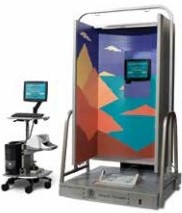
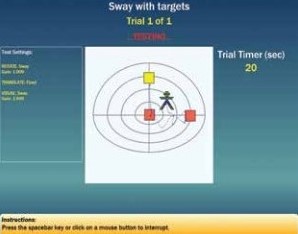
What’s new? I’m back in the penalty box. For those of you who don’t know about the penalty box: it’s actual name is the NeuroCom Smart Balance Master. An aesthetically-insulting contraption developed by NASA grants, it’s the least fun you can have while wearing a harness. The walls and floor move (independently, with/without one another), and some activities are paired with feedback from the screen:

I’m going to pause, allowing you to work through and beyond your jealousy.

Sounds not all that bad, right? WRONG. First of all, you’re not in this thing just because it’s the closest you’re ever going to get to riding any sort of board ever again; you’re in it because you have the balance of an octogenarian (or worse!). Secondly, you’re actually doing more thinking than one realizes, plus tracking the cursor on the screen…and if you’re lucky, you’re doing this while fighting through nausea. If your eyes aren’t tracking well and your brain has slowed to a crawl, it can be a real hoot. My body/mind respond differently from session to session; however, it never ceases to amaze me just how exhausting ~45 minutes in the penalty box can really be! Pro tip: if you’re going to hang out in this thing, make sure you have a friendly, enjoyable Physical Therapist – it makes all the difference. I’d offer mine, but I don’t share (and, let’s be honest: I need him).

I have to admit that there is one thing I really like about the penalty box: quantitative results. Given the number of concussed athletes, I doubt I am alone in my frustration with concussion recovery: so many of the therapies can seem so subjective! Some of us want numbers: we want to know exactly where we stand (okay, sway); we want to know just how productive we’ve been and therefore how successful the therapy is; we want a number to identify, compete against, and ultimately crush!

So let’s talk through some of those numbers. At the end of an assessment, the penalty box spits out a number between 1-100. The first time I did a series of sessions in the penalty box, I started at 55. After several sessions, I ended with an 89(!), and no more ataxia. A couple more concussions meant another round of sessions: started at 34…plateaued at 55. We did some old-school therapy, then tried again: final score for that round of sessions: 86.

Yesterday was my first day of this session…and I’m starting at 36. Who knows what my progress will look like this time: maybe I finally break the 90’s…maybe I don’t even crack 80. Here’s the great thing, though: the numbers really don’t bother me. Several concussions ago, I would have gotten really down – people twice my age could easily manage a score twice mine; however, one of the many things all these concussions have taught me is that a low score is just a great start for an awesome comeback…or at least that’s what I’ve learned to tell myself…

Have you done work in the penalty box (NeuroCom Smart Balance Master)? I would love to hear about your experience!

Life after concussion(s).

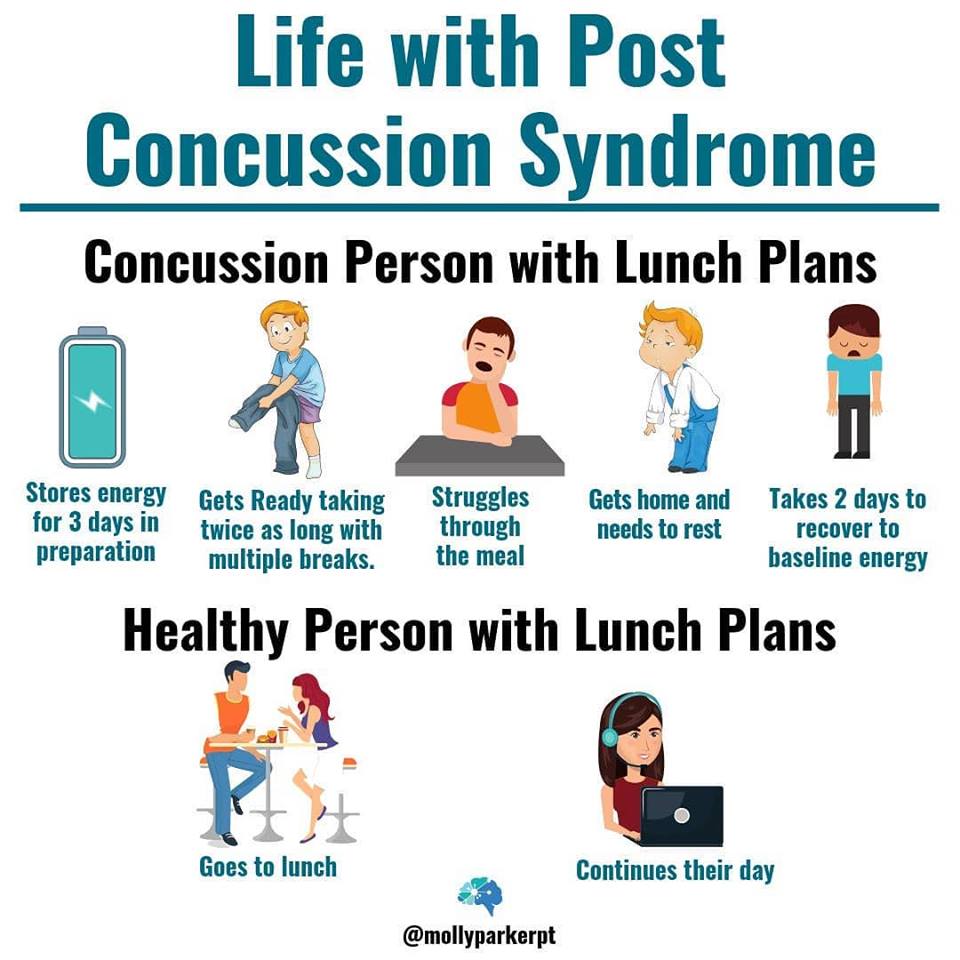
used with permission: @mollyparkerpt

I really appreciate this illustration. While I cannot speak for others, I find that it rings quite true for me. Budgeting my life has become a necessity, more so than for others. When I think through activities I plan to partake in throughout the week, I have to assign them a value – an estimate of how much energy I think each activity will require. But what happens when your week deviates from your stringent calculations, and the realities of life don’t match your calculations on paper? What happens when a family member has a personal crisis? Someone you love has a terrible accident? Work takes more out of you than normal? Allergies knock you down? What happens when there are successive weeks of this?

NOTHING; nothing happens.

Dishes and laundry pile up. Grocery shopping doesn’t happen. Your car, once pristine, slowly begins to look as if you live in it; you start to suspect that the baristas at your nearby drive-thru Starbucks recognize your voice, and you’re too tired to think anything other than “oh good, they’ll know it’s me and my order won’t get too screwed up”. Before you know it, you’re buried beneath obligations, outstanding chores, dirty clothes and laundry, a stinky dog, a needy cat…and you’re still having to divert all your energy outside of your home, to the job that keeps your bills paid and provides you with the blessing of health insurance.

Life doesn’t stop. Obligations don’t dissipate, houses don’t clean themselves, blog posts don’t spontaneously appear. Look again at the illustration above. If you’re in the top row: be gracious and kind to yourself; it won’t be this way forever. It’s my experience that you’ll either learn to compensate or begin to recover; if you’re lucky, both. Hang in there, do what you can, and ask for help if/when you need it. If you’re in the bottom row: just be glad I made it to lunch. I say that jokingly…but also seriously. Be encouraging. Pretend you don’t notice I am wearing pajama bottoms. No, I didn’t shower before we met up…but please don’t take that personally – I woke up and decided that spending time with you was more important than freshly washed hair, and it really was an either/or that morning.

Why the blog?

Why am I writing this blog? What is the point?

There are an increasing number of resources out there for concussion recovery and Post Concussion Syndrome (PCS). Over the last few years, I have combed through and read over many websites and blogs; suffice to say, there are a lot of voices out there with a lot of different things to say. Nonetheless, as I read through all of this (particularly the blogs), I noticed one voice was missing – mine.

There is a tremendous amount being published for and/or by recovering athletes, caregivers, medical providers…but in all of that, I didn’t hear a voice that sounded familiar. I didn’t hear the voice of the average person who is fighting to figure out how all of this fits into a generic routine/life; the person who wants to get back to being able to go to work or school and still have a life outside those duties…the person who just wants to know how to get through each day.

I also realize that I have a somewhat unique perspective. While concussions vary from person to person (and concussion to concussion), I have collected enough concussions at this point that I’ve been able to identify patterns/recurring issues, and have had the opportunity to work through solutions/aids/workarounds concussion by concussion.

My unique perspective also includes the hard things: the crushing sense of defeat that comes when a therapy that lead to amazing results before is completely ineffective a few concussions later; the way lingering concussion symptoms chip away at your life and spirit; the grief that comes with being told you can no longer do the things you most enjoy. I have come to understand how an invisible injury is a double-edged sword: sometimes it’s nice to be able to hide your status as the walking wounded; other times, you wish you had a sign around your neck so that people would know why you’re having to do the things you’re doing.

On a personal level, I’m doing this for myself. As an intelligent individual who has always been articulate and eager to participate in stimulating conversations, developing cognitive deficits which limit me from being able to participate in these conversations has had a tremendous impact in my life. Though it sounds like a singular issue, the ripple effect this has had on my life is astounding…and devastating. This is my way of having a voice and engaging in conversation; this is my way of still being me. My life is impacted by concussions; my choices are informed by concussions…but who I am is not defined by concussions. I am still in here, and I still have a voice.