Ears & Parts & Brains & Hearts.

Please keep in mind that all I can speak to are my own experiences, reflections, and ponderings; these are things that ring true to me.

Before we get to ears, let’s talk about what’s between them – that big, beautiful brain that just got bonked. Mental health HAS to be one of your considerations in recovery because it simply cannot be unaffected (which isn’t to say that a hit to your mental health is always going to be obvious). You’ve literally injured your brain, the seat of who you are. You’ve wounded it physically, chemically, and psychologically. We are holistic creatures, which means that the overused cliché is also completely accurate: mental health is health.

After dozens of concussions and years of therapy, I only just grew to understand that trauma is trauma, regardless of the form it takes. Head trauma (brain injuries) and heart trauma (mental health injuries, if you will) are both trauma, and as such, it has served me poorly to not apply concepts for addressing one to the other as well. In Brain Blame Games, part two., I shared about how reframing my perspective, particularly regarding deficits and limitations, made “such a tremendous difference”, and that absolutely still holds true (6+ years later!). However, it wasn’t until yesterday that I realized reframing my thoughts wasn’t the only change that transpired; what allowed for healthy, lasting change was moving from desperation to eradicate to striving to integrate.

Earlier this week, I was conversing with a wise man I am honored to count as a friend. In addition to being a top-notch human, he’s also a skilled counselor. I asked about a book I saw on his desk and was introduced to We All Have Parts, an excellent book on “healing trauma with internal family systems.” It’s a profound yet unintimidating book, and there are lots of lovely things I could say about it, but suffice it to say that the book made an impression on me. This elegantly simple little book helped me realize that the real shift was from a mission of eradication to a desire for integration. After years of fighting to eradicate the scars and marks of trauma, I was finally introduced to the concept of integrating the messages my somatic system is trying to send into my responses.

Here’s how I see eradication vs integration:

Eradication says that trauma responses resurfacing mean you’re already drowning; integration says that trauma responses resurfacing mean your system is trying to keep you afloat for as long as possible.

Eradication provokes fear and establishes negative connotations; integration provokes self-reflection and establishes positive connotations.

There’s no real choice to be made.
Logic demands it; acceptance and partnership are key.

Consider this: my ears ring all the time now, sometimes soft like the bell on a kitten, sometimes overbearing like an 8th century church bell. It used to make me angry; suddenly, it felt like work to listen. Eventually, begrudgingly, I detected patterns and accepted that my ears aren’t ringing to piss me off – they’re ringing to get me to listen up, to pay attention.  Something is wrong; my brain’s warning light has come on, so to speak.  I learned to appreciate the tinnitus and it has become a tool I can’t live without – I have a gauge for my brain wired into my ears! Instead of suddenly sputtering to a stop, I can now better calculate my current and forecasted capacity. It buys me time and helps me make informed decisions…or at least the best, most informed decision my broken brain is capable of making at the time. I have grown from getting suddenly stuck to understanding how to use the tools I have to efficiently maintain momentum and forward motion.

It turns out my integrative response to my tinnitus should also be the modality I employ on behalf of my mental health, too. The concept of integrating these somatic messages makes perfect sense. It also makes obvious that choosing eradication has inadvertently left me unprepared and caught unaware when trauma resurfaces. As someone who craves efficiency and always strives to make informed decisions, integration then becomes the only worthwhile choice. I’m trapped in a symbiotic relationship with this brain for the rest of my life; I may as well make sure it’s effective, because it’s clearly not going to stop trying to help (whether I like it or not)!
Brain blame games, part two.

So what changed? I learned where else to place the blame. Oh, not what you were expecting to hear?

I slowly began to learn that blaming my brain was simply too broad a complaint, and that it (ironically) limited my ability to be hopeful about recovery. The biggest steps forward came from understanding how injuring my brain affects my eyes. Eye dysfunction can have a huge impact in life overall! If my eyes are sending completely different reports to my brain, my poor brain is having to work so much harder, as it now has to decode the messages and figure out what is actually going on; this, in turn, has a significant impact on cognition. If my brain is having to put so much work into figuring out what I am seeing, it’s that much harder for it to do other things. For example, if my brain is fighting just to figure out which line I am trying to read in a paragraph, of course it is going to be more difficult to actually remember what was written in that line.

This was a massive game-changer! I cannot express what a difference it made to reframe the thought “I can’t remember anything I read because my stupid brain is broken” to “OT will help my eyes do their job better, so my brain can do it’s job better; maybe then I’ll be able to curl up with a book again!”. I began to feel so much less helpless and frustrated; I finally felt like I was no longer hijacked by a broken brain, and had renewed faith in all the various rehab exercises I was doing. I could now face each new concussion with the thought “such-and-such is on the fritz, so I need to check in with so-and-so (OT, PT, SP) to get a tune-up” rather than “oh great – I just screwed everything up even more, and now my brain is that much more useless”. I cannot emphasize how important this has been: when you’re dealing with injuries that already have issues like anxiety and depression as symptoms, knowing that not all is lost can make all the difference in the world. Now, when I whack my head and find that the carpet appears to be rolling like the ocean, I remind myself that I have a super awesome OT and Neuro-Optometrist, and that we will work together to make the carpet stop moving.

Does this mean everything is rainbows and roses now? No. There are still things my brain cannot do that it used to be able to…but I’ve learned to accept that, and put my energy into fixing what I can and adapting to what I cannot. It’s a process, and I still have to remind myself to choose to embrace this perspective, but it has made such a profound difference already, and I’m looking forward to seeing the impact in the future as well.

Brain blame games, part one.

If we go back about three years/nine concussions ago, we would find a very different version of concussed me. EVERYTHING was frustrating and disheartening. Occupational Therapy made me want to cry: how can a string with some beads on it make me feel so broken?! Speech Therapy was soul-crushing: no, I really don’t remember the string of words you just read to me. The list of frustrations, “setbacks”, and deficits seemed utterly insurmountable most days…and it was just the beginning.

A couple concussions later found me in an even darker place. At one point, I was seeing four PT’s, one OT, one SP, one Neuro-Optometrist, and four MD specialists. When I would check in at the rehab desk, they no longer asked my name – they’d ask which therapist I was there to see (or, on bad days, tell me which therapist I was there to see). Life outside rehab wasn’t any easier. I couldn’t drive, so I would often take the bus everywhere. I couldn’t walk a straight line so I was often mistaken as being drunk; this led to some pretty unsettling interactions with strange men at bus stops (bonus: since it was early spring, it would get dark quite early, which really adds a special something to interactions with skeevy individuals). It was ~3 months before I was cleared to return back to work, so I was bored out of my mind. I tried to find things to occupy my time; for example, I tried to learn to knit. Despite learning the absolute easiest, three-step knitting technique, I would get stuck every few minutes, and have to ask my endlessly-patient friend where I was at in the process, and how to continue. I was in my early-thirties, failing at tasks demented senior citizens could do; I was despondent.

Since my brain was what had been injured, all of this fall-out must be my brain’s fault, right? At some point, it had all become clear to me: my brain was public enemy number one, and all hope was officially lost. What I failed to realize at the time was that my biggest challenge wasn’t my brain – it was my attitude. I had no idea how to move forward, what hopes or plans for the future seemed feasible; I had no idea how to go back to simply living life.

*Stay tuned for part two.*

My inner stranger.

Ninety percent of the world’s woe comes from people not knowing themselves, their abilities, their frailties, and even their real virtues. Most of us go almost all the way through life as complete strangers to ourselves.

Sidney J. Harris, American Journalist, 1917–1986

Three years ago, I was petrified. My brain was different – it felt as though I had been hijacked. My mind was slow, clumsy, deficient. As someone who has always relied heavily on their intellect, I felt utterly, terrifyingly abandoned…by a piece of myself which was still technically there, but didn’t feel like mine anymore. If you had told me then that I would come to be somewhat grateful for this, I would have scoffed (at best; more likely, I would have been mad). In some ways it’s as though I had allowed my intellect to replace my identity; I had mistaken who I was with what I was capable of.

One thing I have never been is artistic. In high school, I was very selective in who my Biology lab partner was: a total burnout with zero academic ambition, but excellent art skills. It was utter symbiosis: I had all the knowledge, and he had all the skill (seriously – no one wants to see me try to draw a crawdad). Fast forward to this last weekend, and you find me disassembling my aunt’s coffee table so I could make it into a wall-mounted plant hanger. I’m not saying that the last three years have made me believe I may be the next Michelangelo; however, I consistently surprise myself with just how creative I am becoming. One has to wonder: is my creative side “new”, or was I so reliant on my intellect that I never stopped to explore and nurture my creativity?

What else have I been missing?

I know that finally figuring out what to do with an unsteady, quirky little coffee table isn’t exactly news-worthy…and yet it is. Slowly but surely, I am figuring out what to do with this unsteady, quirky little brain. I have slowly learned to love my brain for the new things it’s mastering, rather than hating it for all the old things it’s forgetting.

PS: I wish I were all sunshine and rainbows about all of this…but I’m not. There will be another post that touches more on that side of things, but know that it’s still a struggle. While I have learned many ways to compensate for the cognitive losses, they are still there, and I am still learning. I still feel the loss; there is still grief. I still doubt my broken little brain, even while striving to show it patience, kindness, and graciousness.

Why the blog?

Why am I writing this blog? What is the point?

There are an increasing number of resources out there for concussion recovery and Post Concussion Syndrome (PCS). Over the last few years, I have combed through and read over many websites and blogs; suffice to say, there are a lot of voices out there with a lot of different things to say. Nonetheless, as I read through all of this (particularly the blogs), I noticed one voice was missing – mine.

There is a tremendous amount being published for and/or by recovering athletes, caregivers, medical providers…but in all of that, I didn’t hear a voice that sounded familiar. I didn’t hear the voice of the average person who is fighting to figure out how all of this fits into a generic routine/life; the person who wants to get back to being able to go to work or school and still have a life outside those duties…the person who just wants to know how to get through each day.

I also realize that I have a somewhat unique perspective. While concussions vary from person to person (and concussion to concussion), I have collected enough concussions at this point that I’ve been able to identify patterns/recurring issues, and have had the opportunity to work through solutions/aids/workarounds concussion by concussion.

My unique perspective also includes the hard things: the crushing sense of defeat that comes when a therapy that lead to amazing results before is completely ineffective a few concussions later; the way lingering concussion symptoms chip away at your life and spirit; the grief that comes with being told you can no longer do the things you most enjoy. I have come to understand how an invisible injury is a double-edged sword: sometimes it’s nice to be able to hide your status as the walking wounded; other times, you wish you had a sign around your neck so that people would know why you’re having to do the things you’re doing.

On a personal level, I’m doing this for myself. As an intelligent individual who has always been articulate and eager to participate in stimulating conversations, developing cognitive deficits which limit me from being able to participate in these conversations has had a tremendous impact in my life. Though it sounds like a singular issue, the ripple effect this has had on my life is astounding…and devastating. This is my way of having a voice and engaging in conversation; this is my way of still being me. My life is impacted by concussions; my choices are informed by concussions…but who I am is not defined by concussions. I am still in here, and I still have a voice.

Surviving sensory overload.

No two brains are the same; this is both the beauty of humanity as well as the curse of brain injuries. It can be quite frustrating that the uniqueness of our brains means there is no one-size-fits-all treatment when it comes to many concussion symptoms; in fact, what is effective/ineffective not only varies from person to person, but can change concussion to concussion for the same person (I can tell you firsthand that this is incredibly frustrating!). In a previous post, I explained that for me, managing sensory overload is often more about reconciling than reducing stimuli. So, what does that actually mean and look like?

Example: it’s been a long week. I have asked a lot of my brain, and it’s getting pretty tuckered out. I’m finally home, hanging out in my chair in front of the TV. I feel tired/drained, but nothing too out of the norm. After a few minutes, I realize that I’ve been bouncing my leg. I don’t feel anxious or overstimulated (yet!)…but I know that my bouncing leg is how my brain warns me it needs a timeout or else it is going to go rogue. My brain is overstimulated…so obviously, now is a good time to play video games!

I know – it sounds counter-intuitive, right? Allow me one caveat, however: I am not talking about playing Call of Duty online with your friends in front of a 4K screen – I feel overwhelmed just thinking about that! For me, when I know my brain is overwhelmed and I have the space/time to do it, I like to sit down in front of my Nintendo classic(s) and play some Zelda or Super Mario (if I’m in a good place in recovery, I can even manage Donkey Kong…but generally, sticking to games which don’t require a quick response time are my jam); think 8 or 16-bit slow-moving, chill games. Super Mario Brothers (1985) is my go-to when I’m really struggling; it captivates and calms my brain, but I can also count on hours of muscle memory to kick in when my brain doesn’t (all those hours playing my Game Boy Color have totally paid off!). Again, for my brain, it’s all about sensory reconciliation: what I am seeing/hearing/feeling are all tied in to keeping Mario alive (hopefully). My brain is engaged enough to not be wandering all over the place, but not so much that it’s overwhelmed and disengaging. Even though Mario may not survive, my brain will, and sometimes that feels huge.

While we’re on the topic of the use of video games in recovery:
if you haven’t heard of her, research Jane McGonigal and her amazing game Superbetter; it may help you or someone you know (no concussion count required!)

Managing sensory overload.

We live in a world which constantly bombards us with stimuli. Sometimes that is exciting and invigorating; other times, exhausting and overwhelming. For those of us who are particularly prone to sensory overload, a world full of stimuli can often feel like a world which we can barely survive. What if we don’t want to just survive – what if we want to thrive?

For me, learning to move past survival mode took a while, but I am so glad I finally took steps forward. The first step was realizing that I did not have to be at the mercy of stimulus; the second step was accepting that would mean making some life changes. The second part was the hardest part; making life changes felt a lot like defeat most days, but forcing myself to look at what I would gain rather than what I was losing was always helpful.

Ultimately, what I have found to be most helpful is viewing stimulus tolerance as something which I could/should budget. While this isn’t something I can really quantify, an informed, educated, experienced estimate is usually possible. I have learned that I really cannot take it day by day – I almost have to take it week by week. Tomorrow’s accomplishments depend on today’s choices, so thinking ahead is a must! Here are some examples of what that means for me:

  • My longest day is followed by the day I work from home. By the time Tuesday night rolls around, my brain is usually feeling pretty wiped. Working from home the next day means I can get a little more sleep, and I have significantly less stimulus (no commute, no noisy office, etc…). I can push myself a bit more on Tuesday because I know that overall, Wednesday is going to be more brain-friendly.
  • I have started inviting people to come to me. In a lot of ways, this is for much the same reason as the Tuesday/Wednesday concept: having them come to me means my environment is controlled and familiar, and energy I want to spend interacting with them hasn’t been “wasted” on driving or the distractions which come from being somewhere other than your own home.
  • Knowing my own limitations is crucial. If I want to participate in a conversation (as opposed to sitting there with a vacant look the whole time), it means there can’t really be more than two or three other people, and it needs to be in a quiet, calm environment.
  • Travel has to be thought through. I was recently stuck in an airport for nine hours on my way home. While I would not have done this previously, I paid the $35 to be in a quiet lounge – I knew that $35 would mean all the difference the next day when I was sitting at my desk.

Learning all of this has not come easily. There are still days when I mourn the loss of “normal life”: being able to sit in a coffee shop with a group of friends and discuss theology; going to a concert; people watching in a busy airport. That said, learning to keep my brain happy is what enables me to get the most out of life.

Avoiding sensory overload.

I have a reputation for always doing things the hard way and stubbornly pushing through things when I shouldn’t (ask any of my concussion rehab providers). I am willing to bet money that my last words will likely be “I got this/I’m good!”…so when I say that avoiding sensory overload is the way to go, please pay attention. I am not proposing sensory deprivation (although that sometimes sounds like a lovely idea!); however, balance is our friend. Additionally, remember that we’re discussing sensory overload, not stimulus in general – there is a whole world out there, and tolerating stimulus is part of the human adventure.

For me, the first step in learning to avoid sensory overload was figuring out how to conceptualize the issue. I started to pay attention to what sensory overload looked like for me (anxiety, inhibited communication, inability to focus, increased pain – the list goes on). As I gained a deeper understanding of the issue, my perspective(s) began to shift. I began to realize some of the impact that sensory overload was having on my life: the toll it was taking on relationships; the increased exhaustion, both mentally and physically; really, my quality of life overall. Interestingly, it also helped me see stimulus in a more positive way. I slowly began to realize that stimulus wasn’t the problem; rather, the problem was my inability to measure stimulus, calculate it’s impact on my day-to-day, and adjust my trajectory when necessary. Sensory overload isn’t something I can or should push through!

Sundays: my number one source of sensory overload. I had not yet identified sensory overload as an issue, and certainly hadn’t realized that it was the primary source of my anxiety; I just knew that when I got to church, my anxiety spiked and things got messy (more on that later…maybe). I started sitting exclusively in the balcony, thinking that being able to see everything and being somewhat separate would help abate my anxiety. NOPE! The anxiety only continued to build, week after week. I had no idea that my “safe” place was possibly one of the worst places for me to be! Once I realized the impact of stimulus in my life, I realized that being up in the balcony, where sounds seem more amplified and every little movement can be observed, was the last place I should be. I felt so defeated when I realized that my previous, uninformed solution was actually making everything worse!

As much as I dislike it, being able to calmly sit through church means:

  • walking in at the last moment (fewer people milling about = reduced visual stimulus),
  • sitting in the very front (I am so glad that lovely friends of mine, who have patiently learned with me how to keep my brain happy, happen to already sit up there!), and
  • shooting out the door the moment church is over (again, fewer people milling about! Bonus: those lovely friends of mine know why I’m sprinting out the door – I don’t have to explain, apologize, or make excuses).

I miss being one of those who is milling about, catching up with my friends. I miss being able to sleep through the service without my pastor noticing (this is largely a joke – except for that one time…). On a cognitive level, I miss hearing the sermon and actually being able to remember and absorb it (the joy of cognitive deficits). I am still figuring this all out. I am still learning how to measure the amount of stimulus I will encounter driving to/from and being in church, how to calculate the impact attending will have on the rest of my week, and figuring out how to make it a priority while also ensuring I will still have the energy to get up the next morning and survive my workweek. I’m trying to remember that when sensory overload is rearing it’s ugly head, my face goes flat and words become hard – this is super important for me to remember, because that can so easily be interpreted as a lack of caring, or me being upset/angry. I haven’t figured out what to do about that yet, but acknowledging it and sharing about it seem like good first steps.

Sensory overload doesn’t have to hold you hostage…but it can if you let it. Acknowledging the power stimulus can have in my life has made a huge difference; learning to respond to it appropriately has helped me feel less like my brain has been hijacked, and more like my brain is a new partner I need to learn to work with. It isn’t easy, and it isn’t fun…but it beats the alternative.

Sensory sensibility, part two.

ILLUSTRATION BY ALOIS DI LEO

Part one concluded with us walking around a corner together…right into the middle of all of this. My brain is starting to power down as a result of overwhelming stimulus; in addition, it is also inducing anxiety, a less-than-subtle cue to the rest of my system that something is really wrong.

So what do we do?  We find a safe place.

It took me a long time to figure out what a safe place for my melting brain should look like, or even that it needed one. I knew something was up; I would come home from a long day at work and my mind would just be done. Sometimes that felt like I had a cement block in my skull; other times, my brain was like a puppy surrounded by squirrels – getting it to focus on anything seemed an insurmountable task.

Recognizing that my brain was overwhelmed and exhausted, I would curl up on the couch in front of the TV – what’s more mindless than television, right?! No matter how mindless whatever I was watching was, I was still unable to quiet my mind and manage my anxiety. I was perplexed by the obvious contradiction: my brain needs a break, yet even with the TV to zone out to, I would still find myself tinkering on my phone or multi-tasking in some other way, as anxiety and restlessness coursed through me. It was a relief when I finally realized a direct correlation between anxiety and stimulus…but if I couldn’t figure out how to respond to sensory overload, I would not be able to actually manage my anxiety. If tinkering on my phone in front of the TV while my leg bounced up and down wasn’t cutting it, what would? What would it take to calm my brain and body, giving both the break they needed? From the beginning, I had looked at the problem purely in terms of numbers: lots of stimulus is bad, so less is good…right?

It took a while, and I stumbled across the solution by accident, but I finally learned that for my broken little brain, it needed a break from unreconciled stimulus. My brain was being drained not so much by the stimuli themselves, but by constantly having to identify each stimulus and figure out where it fit. My brain didn’t want to be placed on a timeout – it just wanted one engaging thing to focus on, and an opportunity to tune everything else out. It may sound simple enough, but identifying this was HUGE. I started off thinking I needed to find a “safe place”…but it turns out that knowing what my brain needs means I can make a lot of spaces safe, giving me one more way I can feel a sense of freedom and control in my recovery process.

I’ll be sharing in another post some of the tools I have found to manage the stimulus and subsequent anxiety (and therefore my brain)…

Sensory sensibility, part one.

ILLUSTRATION BY ALOIS DI LEO

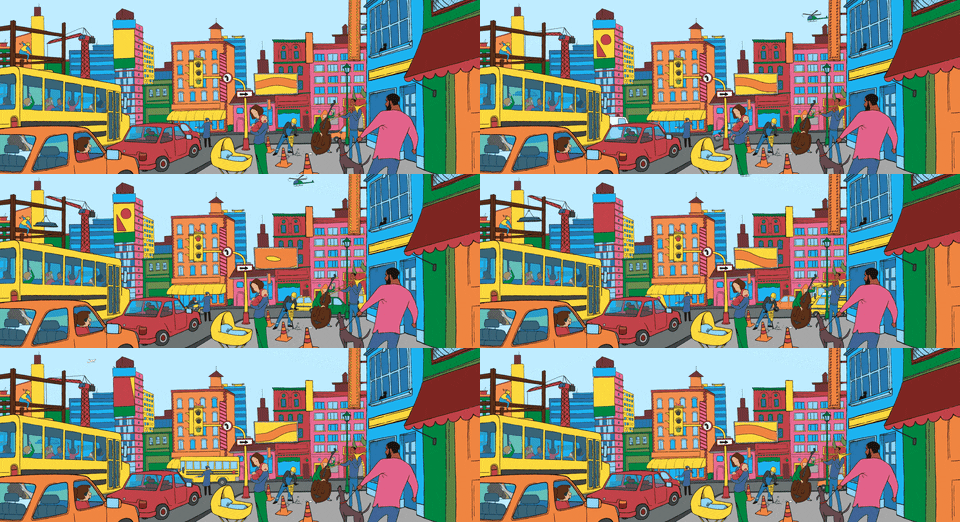
Stop for a moment and take in the scene – really look around. For those of us accustom to city life, it looks pretty normal, right?

Now start adding the layers.

Look closer at all the movement. Everyone and everything seems to be moving, but none of those movements seem abnormal, right? To the average person, it’s just another day in the neighborhood. Add in the smells: dog, smog, cement dust. Getting a little more real, but nothing too bad, right? What sensations do you feel? A light breeze, the feeling of the concrete shaking beneath you, maybe warmth from the coffee cup in your hands. Now for the sounds: an airplane…then a helicopter. A dog barking at the birds chirping from their nest on the stoplight. The crying baby near the musicians who continue to play on despite the jackhammer next to them. The traffic cop blowing his whistle at the cars that are noisily zooming by. The woman on her cellphone in the car next to you – you can hear her talking, but can’t quite tell what she’s saying over the sounds of an idling bus and the rambunctious children it contains. At this point, can anyone even pick out the sound of the steelworker hammering, or the noises filling the work site the crane is at?

Go back and look at the picture again.  Now what do you see?

Perhaps you now see what I immediately saw: commotion and (relatively controlled) chaos. A few years ago, being in this scene would have invigorated me; now, my brain doesn’t know what to focus on – there’s simply too much happening, so my brain begins hemorrhaging power.

Imagine we are walking down this sidewalk together – we’ve just rounded the corner and stepped right into the middle of all this. Our conversation stops because I can’t seem to come up with more than one or two monosyllabic words, which come out in a flat, dead tone. You say my name a few times, and when I do finally realize you’re saying something, I seem dazed and a little confused. My face and affect are flat, my eyes wide. You reach out to touch my arm, and I startle (and, knowing me, likely spill the coffee in my hand). My anxiety increases as my mental capacity decreases; my brain is completely overwhelmed! I can’t focus well enough to tell you what I need; in fact, it was only a few concussions ago when I realized that all of this is being driven by stimulus.

So here we are, standing in the middle of the sidewalk, surrounded by the sights/sounds/smells of life (including my coffee-drenched sleeve). I look at you, my face blank and absent; you look at me, uncertain and concerned.

So now what?

*Stay tuned for part two*

Redefining the win.

We live in a world obsessed with numbers and results. We want quantifiable data and concrete feedback. We want to know how we measure up – we want the win.

“Focus on the positive”, “be patient with yourself”, “give yourself time”…when you’re fighting through recovery, phrases such as these can seem trite. When your brain is struggling with even the most simple, straight-forward things, how do you take a concept like patience/positive outlook and figure out how to apply it to your frustrating situation?

Reframe your situation by redefining the win, and start with the small, easy things. One task where I’ve seen this concept make a big difference is changing my sheets. I always buy my bed sheets from the same place, because they are amazing: on the inside of the bottom sheet, they have tags telling you which are the sides and which are the ends. Initially, I could only view my reliance on those tags as one more sign of my brain’s brokenness. I chose to let my frustration drain me; all I could see was how hard something “easy” had become.

Slowly, I began to break this negative pattern. Instead of being short-sighted and focusing solely on that single task, I fought to broaden my perspective. Rather than looking at the tags as reminders of what had been “taken” from me, I began to focus on what those tags could give back to me. Objects are only negative or positive if we assign them a value. It became so much easier to view them positively once I began to ask myself “what can I do with the mental/physical energy these tags save me?” An extra chapter read, a sink absent dirty dishes, time for an extra-long shower – these things feel a lot like winning!

This perspective shift may not come easily; I certainly found it to be a struggle! You may find it is not an innate perspective; for me, it is definitely a way of thinking I have to choose to have. It is so worth it, though: in the world of recovery, where control and wins seem so few and far between, why not seize them at every opportunity?